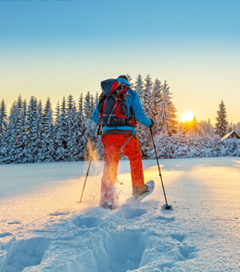
Feature article: Practicing winter sports safely for people with epilepsy.
It is really starting to feel like winter and although different people feel less than thrilled with the snow, ice and the cold temperatures, sometimes it can be fun to get out in the lower temperatures.
Some believe that people with epilepsy (PWEs) should not participate in sports and exercise. This is partly due to fear, overprotection, and perhaps some ignorance regarding the benefits of physical activity. However, there is a growing body of research that shows that exercise does not only promote general health but may in fact affect seizure control for the better.
Having said that, let’s discuss the activities that many enjoy during the winter months and let’s see how PWEs might approach them.
First off, all types of sports vary in terms of risk levels. For example, cross country skiing can be considered safer than downhill skiing and snowboarding. And of course, ice hockey, ski jumping or ice climbing can be considered the riskiest of all. Regardless of the specific sport that the individual is considering, it is always best to consult with the neurologist to determine if there might be certain restrictions or safety issues to consider.
In the following section, we are going to examine some typical winter sports and general guidelines and points to consider. For all of these, remember that speaking with the doctor while considering the PWE’s specific details (e.g., is the PWEs epilepsy well controlled, nocturnal seizures, photosensitive epilepsy, seizures triggered by hyperventilation or altitude, etc.) is a must before starting to practice any of these sports. Also, it is an excellent rule of thumb to have a buddy (who knows the seizure action plan, can call for help, or assist in another way) and to inform people if you are going to be heading off the beaten track.
• Skiing and Snowboarding: For a PWE with well-controlled epilepsy, these sports are relatively safe. It is important to remember to always wear a helmet to protect against head injuries.
• Ice Skating: This can be fun and safe but the individual might consider using protective gear and a helmet to avoid head injuries.
• Sledding: It is important to avoid high speeds and dangerous terrain. Wearing a helmet is recommended.
• Cross-Country Skiing: This is generally safer than downhill skiing since there is less risk of high-speed falls or collisions, but skiing with a buddy and wearing a helmet is still recommended.
Some additional safety recommendations that may be helpful to consider:
• Physical Exertion: Avoid overdoing it: Extreme physical exertion can lower seizure threshold.
• Heat and Dehydration: Watch out if exercise is leading to becoming overheated and make sure to hydrate regularly
• Stress and Anxiety: Some can find the pressure and expectations involved in competitive sports to be stressful. If stress is a seizure trigger, it is important to take this into account, consider using reframing and relaxation techniques, etc.
• Sleep Deprivation: When training, it may be necessary to wake up early for morning training or late-night competitions, leading to sleep deprivation. Be mindful of this and discuss with the doctor, coaches, etc.
• Flashes or Flickers: Special care is recommended for PWEs with photosensitive epilepsy flickering lights or certain patterns, which might occur for example when skiing through tree-covered paths or gym lights.
• Head Injury: Consider avoiding sports that might commonly result in head injuries
• Hypoglycemia: Avoid skipping meals before or during sports because that can result in low blood sugar levels.
• Medication Missed or Adjusted: Skipping medication doses or changing the schedule when medications are taken could be problematic.
• Altitude and Oxygen Levels: Practicing a sport in an area with high altitude might reduce oxygen levels and should be carefully considered.
In summary, exercise, including winter sports, can be positive for PWEs not only because exercise can improve physical health and mood, can reduce stress, and in some cases and for some individuals, can even reduce seizure frequency (see ultramarathon runner, Diane Van Deren’s, story: https://www.theatlantic.com/health/archive/2014/12/running-from-the-seizures/383123/). As long as necessary precautions are taken and the individual’s epilepsy characteristics (e.g., seizure frequency and type) are carefully evaluated with the doctor, the joy of exercising in all seasons may be possible for many PWEs.

