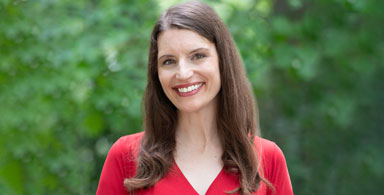
For our September issue, we are excited to feature our Seizure Star, author and filmmaker, Stacia Kalinoski, who recently published Racing Uphill: Confronting A Life with Epilepsy.
Epilepsy Star: For our September issue, we are excited to feature our Seizure Star, author and filmmaker, Stacia Kalinoski, who published Racing Uphill: Confronting A Life with Epilepsy. Your voice has reached so many through your documentary Brainstorm and now, your memoire, Racing Uphill. You are a tireless advocate for those living with epilepsy which is why we thank you for agreeing to be our September Epilepsy Star and for telling us more about the amazing work you do for the epilepsy community.
a) Please tell us how epilepsy came into your life and some of the challenges you have faced as a result?
I was healthy growing up, and then I had my first seizure out of the blue my junior year of college at the University of Minnesota, at the start of cross-country season. Then I had another one, where I fell out of my bunk bed. After that they seemed to go away, so in 2007 I moved on with my life, moved out to Nebraska for a reporting job, and two years later, I moved to Oregon for another reporting job. There, I was 25 years old, working crazy hours and training for my third marathon, and right after that marathon in Seattle, seizures came back with a vengeance. They continued to worsen and eventually changed from tonic clonics to ones that my epileptologist called bizarre and unique. I go into more detail in the book.
Epilepsy turned many aspects of my job and lifestyle into a challenge, as many people with epilepsy can relate to. My memory problems impacted my job and relationships, and
I started having intense jamais vu auras when I was out running so I had to stop marathon training. I also needed a driver at work which made me feel like a burden.
b) Tell us about how your documentary, Brainstorm came to be and what was your motivation to create it.
Unfortunately, a seizure ended my career in 2014. I knew I had to take control of my health at that point or I would never be able to work again. I moved back to Minnesota, started surgery work-up right away with my new epileptologist, and when she told me I qualified for brain surgery, the idea came to me in her office to create a documentary to educate people about epilepsy. Two years later, Brainstorm premiered on the Minnesota PBS station, aired on PBS stations across the country, and the International League Against Epilepsy streamed it on their website for a year.
c) Tell us about your newest project, your book, Racing Uphill, and what you hope this book will achieve. Who do you think should read it?
My goal with Racing Uphill was to give readers something to walk away with besides a story of resiliency. It was my opportunity to truly educate people because epilepsy is so complex. I interviewed a neurosurgeon and two epileptologists (one of them mine) and I weave that information into my story, in various chapters. So I am hopeful that people with no relationship to epilepsy will be interested in learning more, because more awareness leads to more empathy and first-aid awareness. The book is also for those with epilepsy who are looking for encouragement and more information on their condition. The book’s subtitle, “Confronting a Life with Epilepsy,” is what I eventually had to do.
Denial plays a big factor in epilepsy, but as I found out, you can only run away from
seizures for so long. Once I lost my career, I had to confront epilepsy.
My core message is: Don’t give up on yourself. That's something I would tell myself.
d) What do you see in your future of advocacy? Tell us about any plans or projects you may be working on.
After the documentary, epilepsy organizations started asking me to speak at their events to share the patient's perspective. I plan to continue speaking now that the book is out, and a few events are lined up. Epilepsy can be so isolating, and the side effects can be so frustrating, so I'm glad I've been able to lend support in online chat groups, zoom calls, emails, and the Epilepsy Foundation of Minnesota's virtual connect group.
e) Is there anything you would like to add.
I jumped at the chance for brain surgery because I knew it was my only chance for seizure freedom. If anyone is a potential candidate, I encourage them to strongly consider surgery because it can be lifesaving and life-changing. I had a cortico-amygdalohippocampectomy, which is a very common surgery for temporal lobe epilepsy.
You can order the book directly from me at: staciaamee.com or https://www.upress.umn.edu/9781517917463/racing-uphill/
Also, listen to Stacia discussing her new book on podcast, Sharp waves: https://www.ilae.org/journals/epigraph/epigraph-vol-27-issue-3-summer-2025/documentary-filmmaker-confronts-epilepsy-in-a-new-memoir-stacia-kalinoski

